London, 15 April 2026 – The global 3D printer market
reached a significant turning point in the fourth quarter of 2025 as
the white-hot Entry-level segment continued to rise as a primary
financial engine, seeing not only accelerating sales but also
attracting massive strategic capital from tech giants. According to
the latest analysis from global market intelligence firm CONTEXT,
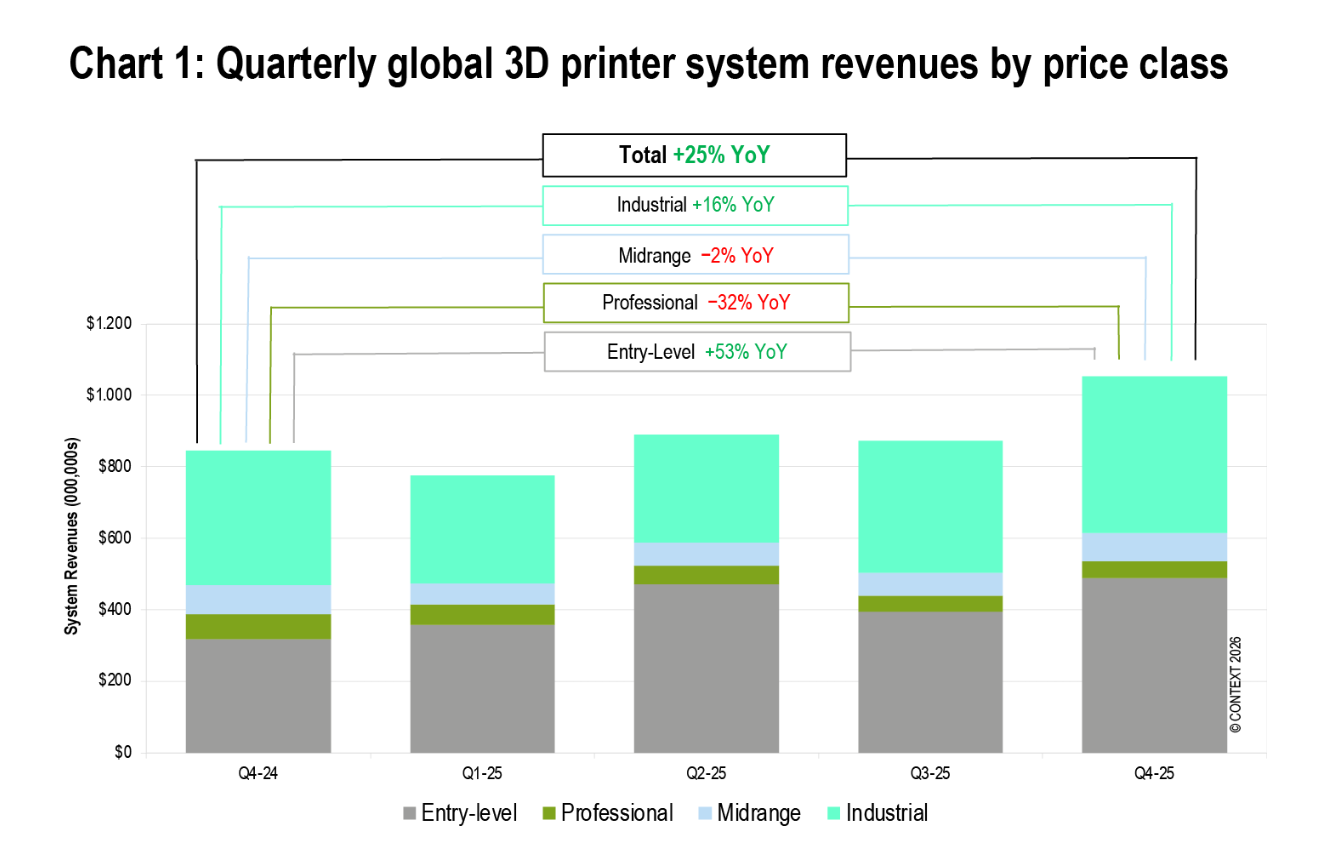
aggregated hardware system revenues rose 25% year-on-year (YoY) in Q4
2025, driven by accelerated Entry-level shipments (up 47%, resulting
in a 53% YoY revenue rise) and rebounding Industrial system shipments
(up 12%, leading to a 16% YoY rise in revenues).This collective uptick
suggests the industry may have finally moved past the "trough of
demand" that characterized the high-end of the market for much of
the previous two years.
Entry-level 3D printing has never been hotter.
Nowhere was this more evident than at the recent TCT Asia show in
Shanghai, which again showcased ongoing technical innovation and
frenetic consumer excitement. While Industrial 3D printing gained
momentum in the second half of 2025, the hype of years past has
largely been replaced by a rigorous focus on key verticals and
strategic areas of growth. While challenges remain in the Midrange and
Professional segments due to the ongoing migration of demand toward
lower price points, a rebound in Industrial shipments across the globe
gives hope that the all-important high-end of the market is again
finding its footing.
Industrial Systems: Resurgence in Polymers and Metals
Global shipments of Industrial price-class
systems (>$100K) rose nicely in Q4 2025, continuing a resurgence
that began in the second half of the year. This strength was not
limited to Metal or to China, but also included invigorated Polymer
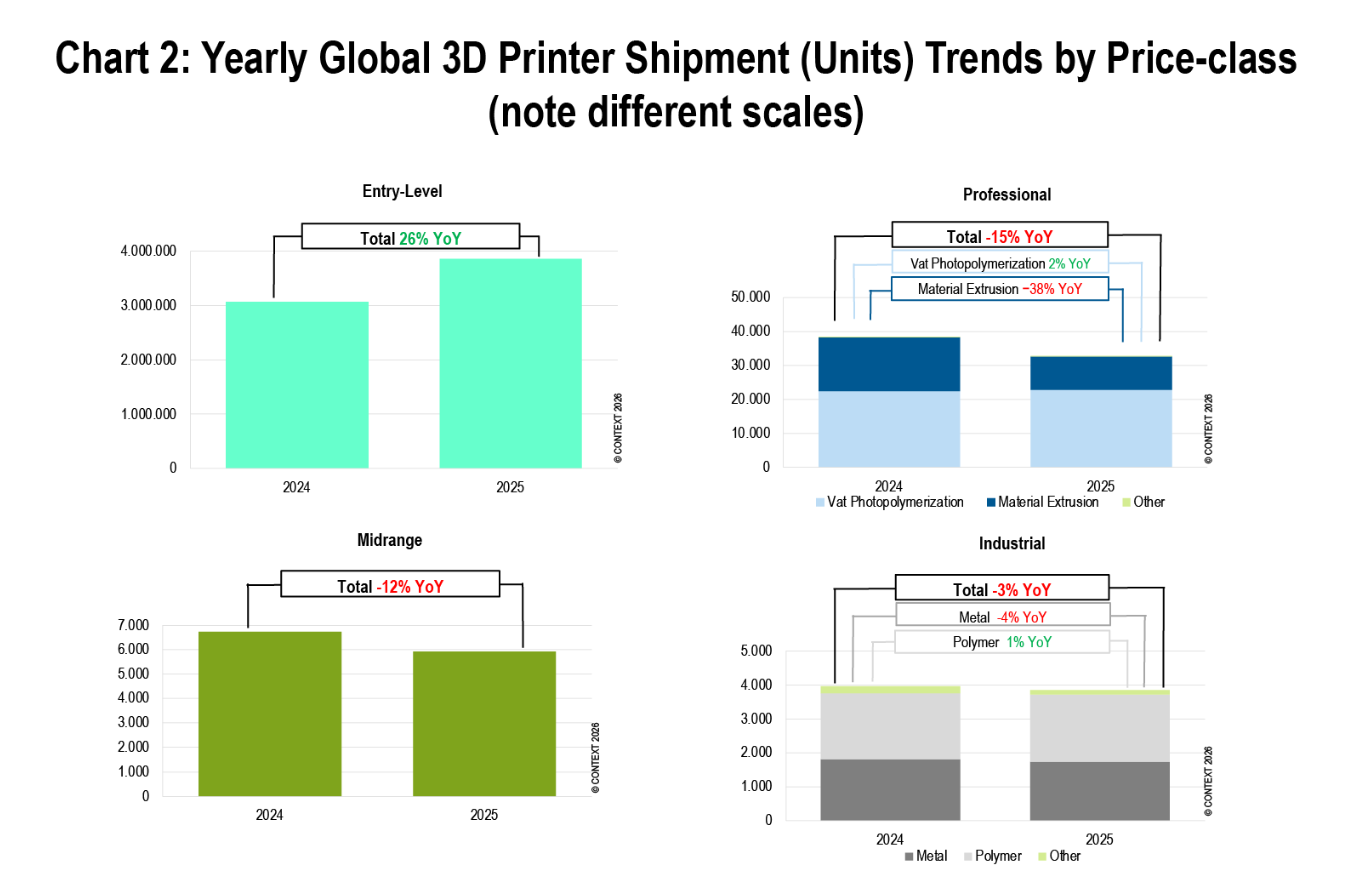
shipments across the globe. While unit volumes for the full year
2025 were down -3%—marking the fourth consecutive year of
declines—the Q4 rebound saw units rise 12% YoY.
-
Polymers: Global shipments for Industrial Polymer 3D
printers were up 23% in the quarter. This was driven by a 39% YoY
shipment surge in Vat Photopolymerization printers, mostly from
a resurgent Carbon and market leader UnionTech. For the full year
2025, Polymer shipments remained essentially flat at 1%.
-
Metals: Industrial Metal system shipments rose 5% in
Q4 2025, driven entirely by rising Metal Powder Bed Fusion (PBF)
shipments. Full-year global Metal shipments (of all
technologies) dropped -4%, impacted significantly by the M&A
chaos seen in the West in 2025, affecting Metal Binder Jetting and
Metal Material Extrusion.
-
Metal Powder Bed
Fusion: This sub-segment grew 24% YoY in units for Q4. Leaders in
unit share included Chinese vendors BLT, Eplus3D, ZRapid
Tech, and Farsoon, while Western vendors EOS and Nikon SLM
Solutions maintained leadership in system revenue share.
UnionTech—a long-time market leader in Polymers—also emerged as a
significant growth driver in Metals, citing strong demand in the
shoe-mold market.
Professional and Midrange Systems: Navigating Downward Pressure
Both categories continued to feel the "Bambu
effect" as demand for Material Extrusion shifted toward
lower price points.
-
Midrange ($20K–$100K): Global shipments were down -6%
YoY in Q4 2025 and down -12% for the full year. Full-year unit
leaders in this technically diverse segment
included UnionTech, Stratasys, Formlabs, and ZRapid Tech. While
the Material Extrusion sub-segment was challenged, Midrange Powder
Bed Fusion shipments grew, particularly through HP's
unique upgrade strategy. This price range also suffered more
severely from market consolidation than others, significantly
impacting YoY comparisons as companies merged, were acquired,
or otherwise dropped out of the category in 2025.
-
Professional ($2.5K–$20K): Shipments contracted -12% in the
quarter and -15% for the full year, mostly due to cratering
Material Extrusion shipments. Products leveraging Vat
Photopolymerization now enjoy the dominant share in this price
class, representing 71% of the Professional products shipped
globally in the quarter. Category leader Formlabs enjoyed the top
market share for the entire year (38%), with global shipments
rising nicely from 2024. New excitement is also building around
lower-priced products leveraging other modalities like continuous
composite fibre systems, such as FibreSeek (formerly Anisoprint),
and from forthcoming, full-colour Material Extrusion printers such
as from Flashforge.
Entry-Level Systems: The New Global Powerhouse
Global shipments of Entry-level 3D printers to
end-customers customers – not only consumers but also prosumers,
professionals and manufacturing print-farms across the globe alike --
surged 47% in Q4 2025 and rose 26% for the year as a whole. China has
become to consumer 3D printing what Japan was to consumer electronics
in the 1980s; almost all technical and price ingenuity currently
originates from Chinese vendors, which accounted for over 90% of
global shipments in 2025. Bambu Lab enjoyed a 37% market share in the
period, while Creality, Elegoo, and Anycubic also held top positions.
The segment is maturing financially, with Creality on the cusp of an
IPO and rumoured multi-billion-dollar investments into other leaders
by Chinese financial heavyweights. Innovations in advanced,
multi-colour solutions remain a strong catalyst, evidenced
by Snapmaker's record-breaking crowdfunding effort. Forthcoming
innovations in Artificial Intelligence, promising to make at-home 3D
printing even easier, also look to push future market growth.
Outlook
The long-term outlook for 3D printing remains
strong across the globe, especially as the technology progresses
beyond prototyping into volume manufacturing. In the near term, all
key price segments are poised for growth in 2026, supported by
loosening US interest rates, continued strength in the domestic China
market, and aerospace and defense momentum across the globe. The
market is expected to see new technology and price-point solutions
come to market in 2026—including composites and full-colour material
jetting—helping even the Professional price class see shipment
growth in the year ahead.
Entry-level is on track to see the highest growth
rate in 2026, while Industrial shipments are set to see YoY growth
rates near double-digit percentages. While the outlook for shipment
growth in the Professional and Midrange segments is more modest for
the year ahead, both are expected to accelerate back to previous peak
levels over the next few years.
Price classes: Entry-level under $2,500;
Professional $2,500 to $20,000; Midrange $20,000 to
$100,000; Industrial above $100,000